Land acquisition financing: how a bridge loan works
Land acquisition financing is the credit that pays for a plot before it has a building licence and works under way, a stage that banks almost always avoid. According to the Observatory of Alternative Mortgage-Backed Financing in Spain, alternative lenders act as a bridge until the project can qualify for a development loan. We explain how it is structured, with an illustrative and hypothetical example, and what risks it carries for investors.
This text is educational. It is not investment advice.
Land acquisition financing: why banks rarely step in
Since 2008, Spanish banks have generally not financed land without a licence, nor the early stages of a project. They ask for pre-sales and equity from the developer. This is set out in the Observatory of Alternative Mortgage-Backed Financing in Spain, with market analysis by PwC and the legal framework by Cuatrecasas (October 2026).
The reason is uncertainty. A plot without a licence depends on planning timetables the developer does not control. Banks prefer to come in once there is a licence, a design and off-plan sales. They step in earlier only exceptionally, with large developers that have a track record. According to the report, some large banks have recently started to finance land on aggressive terms to secure the later development loan and the buyers’ mortgage subrogations.
The result is a funding gap in the first stage. It is the same problem we saw in the Spanish housing shortage: without financed land, construction does not start.
Who finances each stage of a development
The Observatory distinguishes several moments of intervention. The chart summarises who usually finances each one.
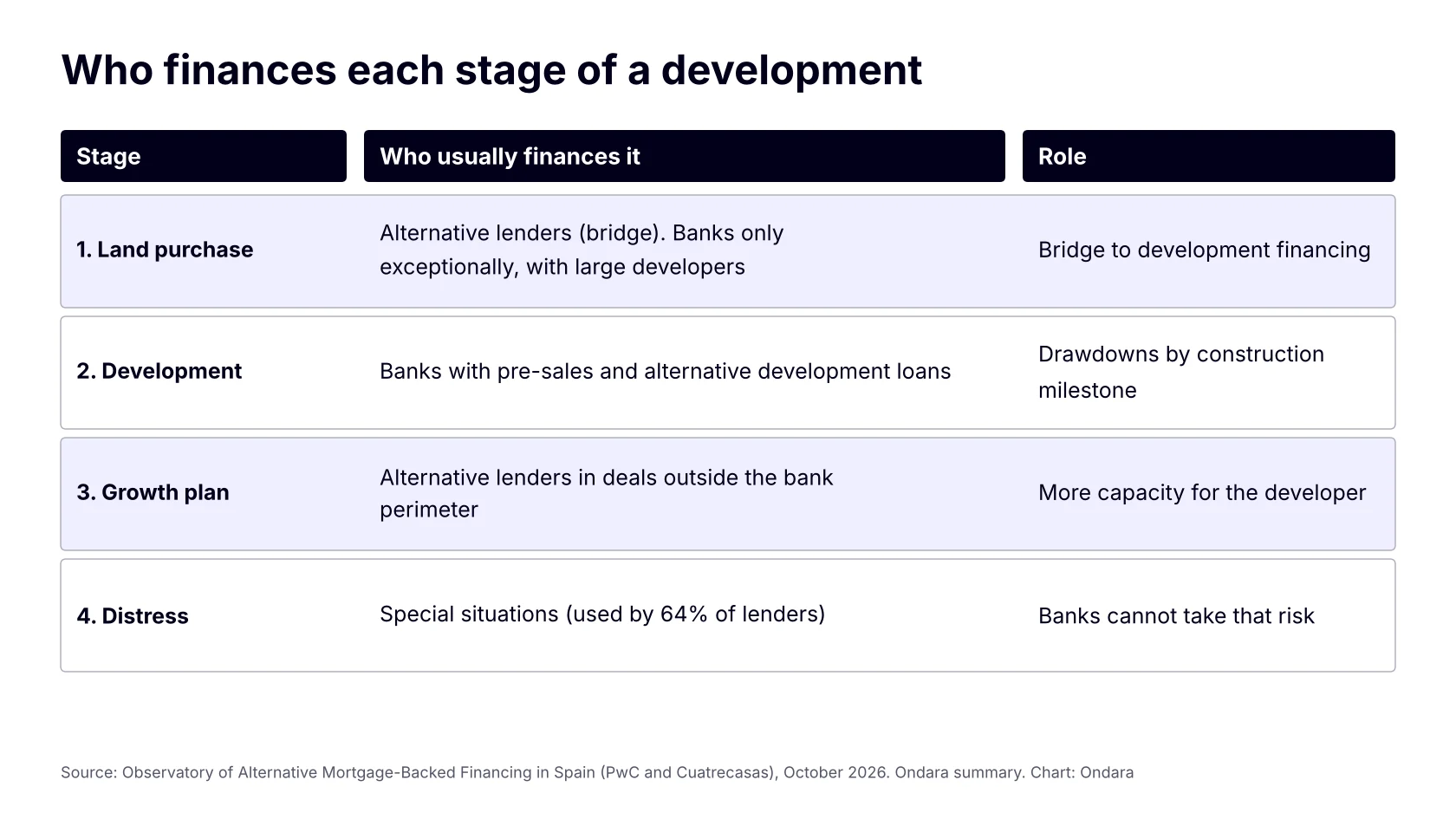
At the land purchase stage, alternative lenders work as a bridge to development financing. During construction, the development loan, bank or alternative, takes over. Special situations sit outside the banks’ perimeter.
How a bridge loan to buy land is structured
In the bridge-to-term model, the bridge covers land, licences and design for 12 to 24 months. The developer then refinances it with a development loan or with sales. The key points are these:
- Collateral: a mortgage over the plot itself, as real collateral.
- LTV: lower than banks use in later stages, because a plot is worth less than a finished building.
- Term: short and tied to a milestone, normally the licence.
- Repayment: a single payment at the end of the term (bullet) or interest only until then.
- Exit: refinancing with a development loan, sale of the land or sale of the development.
The legal and tax aspects of the model are covered in our article on bridge-to-term financing.
As a market reference, the Observatory gives these average terms for alternative mortgage-backed debt. They are not Ondara’s terms and do not refer only to land deals.
| Term | Average | Range |
|---|---|---|
| LTV | 55% | 30% – 68% |
| Interest rate | 10% | 7% – 20% |
| Term | 28 months | 11 – 72 months |
| Average ticket | EUR 4.9 million | EUR 0.8 – 58.3 million |
Illustrative and hypothetical example of a land bridge loan
Suppose a plot valued at EUR 4,000,000. A lender grants a loan with a 55% LTV, a 10% annual rate and an 18-month term, repaid at the end. These are market figures from the table above, used only as assumptions.
| Item | Amount |
|---|---|
| Appraised value of the plot | EUR 4,000,000 |
| Loan (55% LTV) | EUR 2,200,000 |
| Developer’s own equity | EUR 1,800,000 |
| Interest over 18 months (10% a year) | EUR 330,000 |
| Total debt to repay | EUR 2,530,000 |
The planned exit would be to refinance with a development loan once the licence arrives. What if the land loses value or the licence is delayed? Debt grows with interest and the real LTV rises:
| Fall in plot value | Value | LTV on principal | LTV with interest |
|---|---|---|---|
| 0% | EUR 4,000,000 | 55.0% | 63.3% |
| -10% | EUR 3,600,000 | 61.1% | 70.3% |
| -20% | EUR 3,200,000 | 68.8% | 79.1% |
| -30% | EUR 2,800,000 | 78.6% | 90.4% |
With a 30% fall, debt including interest is close to the value of the collateral. That is why the starting LTV and the safety margin matter so much. This is a hypothetical example: it does not reflect any real transaction.
Trends: what is happening worldwide and in Spain
- Worldwide, 15 October 2026: according to Reuters, direct lending funds raised USD 129.15 billion in the first nine months of 2026 (+35%, Preqin data), while third-quarter lending fell 28% year on year (PitchBook/LCD data). There is more capital than deals. For investors, that pressure can lead to looser terms, so the collateral and structure of each deal need close scrutiny.
- Spain, 9 October 2026: at the V National Housing Congress in Barcelona, the president of APCE (Spain’s developers’ association), Xavier Vilajoana, called for a new land law, less red tape and for banks and alternative finance to complement each other, according to Capital (in Spanish). The land bottleneck is not only financial: it is also a planning issue.
- Spain, October 2026: the Observatory puts alternative finance at 20% of financing in Spain, against 75% in the US, 50% in the UK and 40% in France and Germany. There is room to grow, but that is no guarantee of results for any single deal.
More market context in alternative mortgage lending in Spain: 2026 figures.
Risks to consider
- Planning risk: the licence may be delayed or refused, and the exit with it.
- Valuation risk: land has fewer price references than a finished home and can lose value.
- Refinancing risk: if the development loan does not arrive, the bridge is not repaid on time.
- Illiquidity and term: capital is tied up until maturity, which can be extended.
- Default and enforcement risk: recovering the collateral can take time and cost money.
- Loss of capital: every investment carries risk, including partial or total loss of capital.
Real estate collateral mitigates risk but does not remove it.
How Ondara works
Since 2018, Ondara Group has structured private debt transactions backed by real estate. We analyse each deal, use real assets as collateral and look to diversify. Investors deal directly with the management team. Ondara pursues target double-digit returns, never guaranteed. The minimum investment is EUR 25,000.
Frequently asked questions
Who finances land purchases in Spain?
Mainly alternative lenders, as a bridge. Banks step in only exceptionally, with large developers that have a track record.
Why don’t banks finance land without a licence?
Because of uncertainty over timing and outcome. They prefer to finance once there is a licence, a design and pre-sales.
How long does a land bridge loan last?
In the bridge-to-term model it usually covers 12 to 24 months, until the licence and the start of works.
What LTV is used for land purchases?
One lower than banks use in later stages. The average for alternative mortgage-backed debt is 55%, according to the Observatory.
Is it a risk-free investment?
No. There is planning, valuation, refinancing and illiquidity risk, and partial or total loss of capital is possible.
In summary
- Banks avoid land without a licence; alternative lenders cover that first stage as a bridge.
- The bridge usually lasts 12 to 24 months and relies on a mortgage over the plot and a clear exit.
- A low starting LTV gives room if land values fall or the licence is delayed.
- Planning, valuation and refinancing risks are specific to this stage.
If you would like to know how we invest, register as an investor and we will explain how it works. The minimum investment is EUR 25,000.
This article is for information purposes only and does not constitute an investment recommendation or financial advice. All investments carry risks, including the possible loss of the capital invested, and past or target returns do not guarantee future returns. Analyse each opportunity with a professional before investing.