Real estate special situations lending: how it works
Real estate special situations lending means secured loans to developers or companies under financial strain that still hold valuable assets and the capacity to repay. According to the Observatory of Alternative Mortgage-Backed Financing in Spain, 64% of alternative lenders in Spain offer it. We explain when it is used, why banks stay out and what risks an investor takes.
This text is educational. It is not investment advice.
Real estate special situations: what they are
The term describes financing for borrowers with a specific liquidity problem who also own assets that back the debt. The Observatory of Alternative Mortgage-Backed Financing in Spain, with market analysis by PwC and the legal framework by Cuatrecasas (October 2026) describes it as liquidity for developers or companies in one of these positions:
- They have credit agreements in force.
- They are going through a restructuring.
- They face insolvency risk (concurso, Spain’s insolvency proceeding) but keep assets with value and the capacity to repay.
According to the report, it is the most expensive type of alternative debt. In return, it gives access to liquidity and keeps the business running. It prevents a cash squeeze from ending in insolvency or liquidation, an outcome that often destroys value for creditors too.
Why banks rarely step in
Banks mainly assess the project and require certain conditions: pre-sales, a building licence, a track record. In a special situation, the problem lies with the borrower, not the project. According to the Observatory, regulation prevents banks from taking that risk. Each Basel review also widens that perimeter. The report cites CRR3, in force since January 2025.
The report concludes that this demand is permanent: it does not depend on one particular cycle. It is a gap that alternative lending fills by design. For wider context on the market, see alternative mortgage lending in Spain: 2026 figures.
Which instruments alternative lenders use
The chart shows the share of lenders offering each instrument. Special situations rank third, behind development loans and bridge loans.
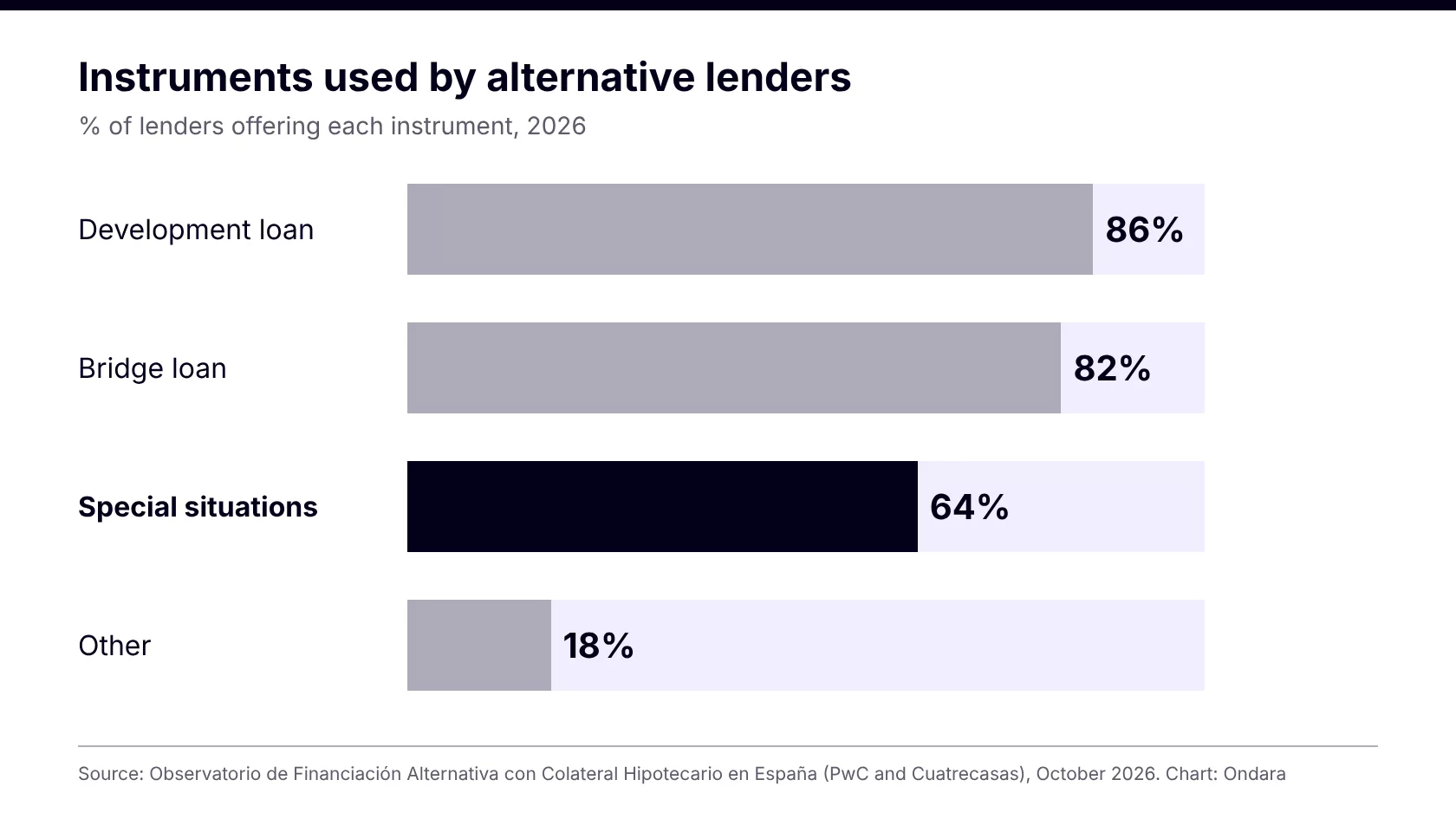
| Instrument | Lenders using it |
|---|---|
| Development loan | 86% |
| Bridge loan | 82% |
| Special situations | 64% |
| Other | 18% |
The shares do not add up to 100% because a single lender can offer several instruments. For the most common one, see how a bridge loan works for land purchases and the legal keys of bridge-to-term.
When it is used: typical situations
These are descriptive examples of situations in which a lender may assess a special transaction. They are not real cases or an offer.
| Situation | What the lender assesses |
|---|---|
| Loan maturing without refinancing | Collateral value and plan to repay or refinance |
| Developer with works halted for lack of cash | State of works, cost to finish and final value |
| Company in restructuring with property assets | Cash generation and asset value |
| Insolvency risk with assets worth more than the debt | Ranking of claims and outlook if proceedings start |
In every case the exit matters: where the money to repay the loan will come from.
Trends: what is happening worldwide and in Spain
- Worldwide, 15 October 2026: according to Reuters, direct lending funds raised USD 129.15 billion in the first nine months of 2026 (Preqin data), while third-quarter lending fell 28% year on year (PitchBook/LCD). There is more capital than deals, which calls for closer scrutiny of each loan’s structure.
- Worldwide, 20 May 2026: an analysis by Moody’s Analytics, reported by Alternative Credit Investor, says about 65% of corporate defaults in 2025 were distressed exchanges and that more than one in three ends in default or a repeat restructuring. See also hidden defaults in private credit and the private credit maturity wall.
- Spain, 6 October 2026: Experian Spain, published by Axesor, counts 4,529 insolvency proceedings to September, 0.22% fewer than a year earlier, although September alone reached 693 (+25.09% year on year). The cumulative decline has stalled. These are private-company data, not official statistics.
For an individual investor, the reading is twofold. Stress situations exist and do not go away, but these are complex transactions that need legal and collateral analysis and do not suit every profile.
Risks to consider
- Default risk: the borrower is already in difficulty, by definition. This is the core risk of the category.
- Insolvency proceedings risk: if the borrower enters insolvency, timelines and the ranking of claims can change.
- Valuation and enforcement risk: recovering the collateral can take time and money, and the property may be worth less than expected.
- Illiquidity and term: capital is tied up and maturity may be extended.
- Complexity: detailed legal analysis and close monitoring are required.
- Loss of capital: every investment carries risk, including partial or total loss of capital.
Property collateral mitigates risk but does not eliminate it.
How Ondara works
Since 2018, Ondara Group has structured private debt transactions backed by real estate. We analyse each transaction, use real assets as collateral and seek diversification. Investors deal directly with the management team. Ondara pursues target double-digit returns, never guaranteed. The minimum investment is EUR 25,000. You can read about the group’s brands on our website.
Frequently asked questions
What are real estate special situations?
Secured loans to developers or companies under financial strain, with credit agreements in force, a restructuring or insolvency risk, that keep assets with value.
Why are they more expensive than other debt?
Because the risk lies with the borrower and not only the project. According to the Observatory, it is the most expensive type of alternative debt.
Why don’t banks provide them?
Because of regulation: according to the report, banks cannot take that risk, and Basel reviews such as CRR3 widen that perimeter.
How many lenders offer them?
64% of alternative lenders, according to the Observatory (October 2026).
Are they a risk-free investment?
No. There is default, insolvency proceedings, valuation and illiquidity risk, and partial or total loss of capital is possible.
In summary
- Special situations finance borrowers with a liquidity squeeze but valuable assets.
- Banks stay out because of regulation, and each Basel review widens that space.
- It is the most expensive alternative debt because it takes the most risk.
- It requires legal analysis, solid collateral and a clear exit.
If you would like to know how we invest, register as an investor and we will explain how it works. The minimum investment is EUR 25,000.
This article is for information purposes only and does not constitute an investment recommendation or financial advice. All investments carry risks, including the possible loss of the capital invested, and past or target returns do not guarantee future returns. Analyse each opportunity with a professional before investing.