Real estate crowdfunding in Spain: 2018-2025 data
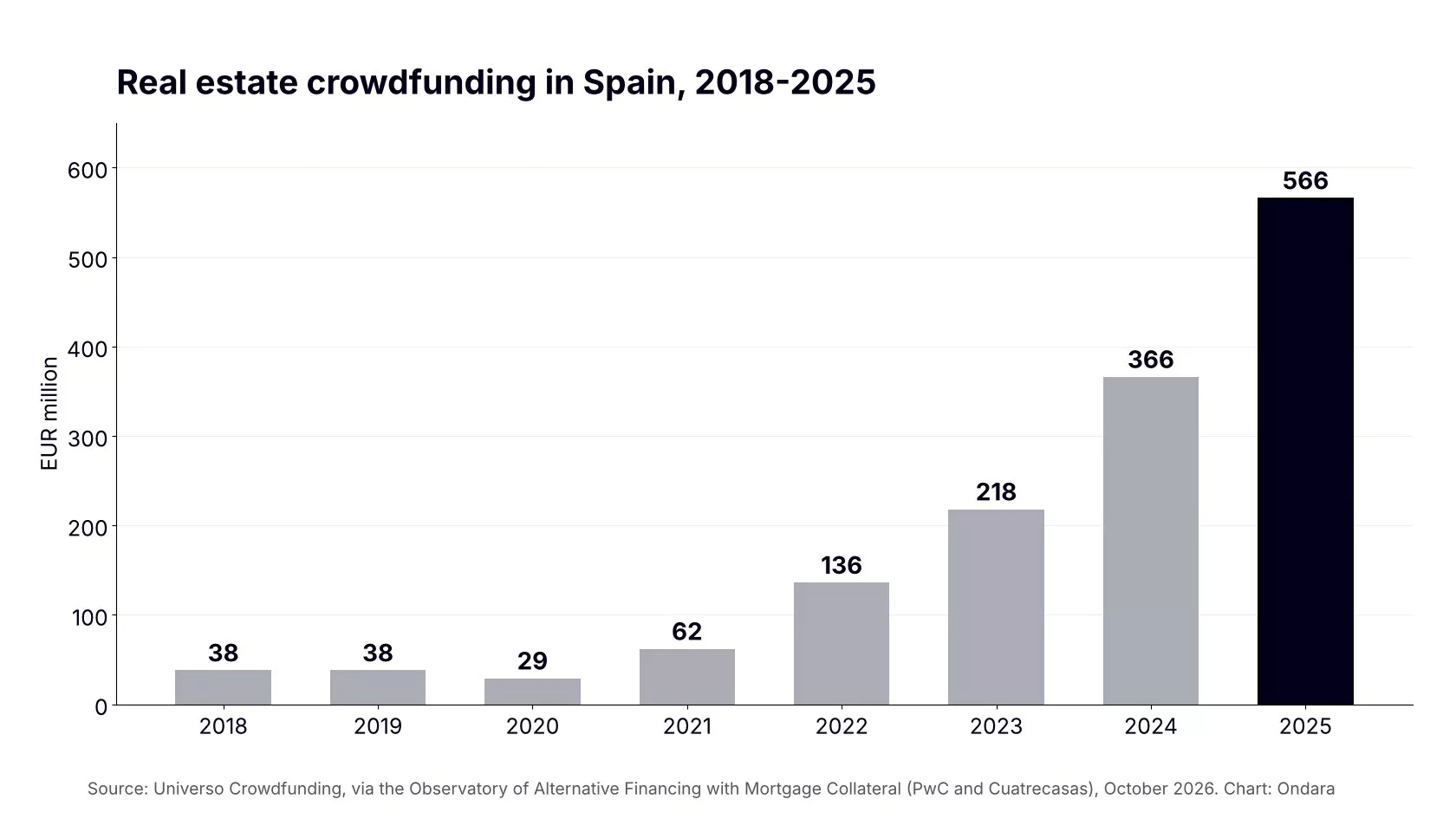
Real estate crowdfunding in Spain raised EUR 566 million in 2025, up from EUR 38 million in 2018, according to Universo Crowdfunding as cited in the Observatory of Alternative Financing with Mortgage Collateral in Spain, with market analysis by PwC and legal framework by Cuatrecasas (October 2026). That is a compound annual growth rate of 47%. Here is what the data says, why figures differ between sources and which risks you should know.
This text is for information only. It is not investment advice or a financial recommendation.
Real estate crowdfunding in Spain: 2018-2025 trend
Real estate crowdfunding lets many investors put small amounts into the same project. The market was small until 2020. Since 2021 it has grown by double digits every year.
| Year | Volume (EUR million) | Annual change |
|---|---|---|
| 2018 | 38 | — |
| 2019 | 38 | 0% |
| 2020 | 29 | -23.7% |
| 2021 | 62 | +113.8% |
| 2022 | 136 | +119.4% |
| 2023 | 218 | +60.3% |
| 2024 | 366 | +67.9% |
| 2025 | 566 | +54.6% |
Why real estate crowdfunding figures do not match
If you compare sources you will see gaps. There are two reasons: scope and cut-off date.
- Universo Crowdfunding counts money raised in campaigns that reached their target, on platforms based in Spain or focused on its market. Its report on 2024, published in 2026, puts real estate crowdfunding at EUR 366.2 million, around 70% of total Spanish crowdfunding (about EUR 522.5 million). In 2023 it was EUR 219.1 million.
- The Observatory questionnaire asks alternative lenders how much they granted. Platforms reported EUR 467 million in 2025, 18% of the total alternative financing secured on mortgage collateral (EUR 2,583 million).
These are different measures: one counts what platforms raise, the other what is lent within the mortgage-secured debt market. Editions of the same source may also revise earlier years. Always cite source, year and scope.
Crowdlending vs crowdfunding: what you actually buy
The two terms are often used as synonyms, but they are not. For a wider view, read our guide on alternative mortgage lending in Spain.
| Feature | Crowdlending | Equity crowdfunding | Direct secured private debt |
|---|---|---|---|
| What you provide | A loan in exchange for interest | A stake in the vehicle’s capital | A loan secured on real assets |
| How you are paid | Interest and repayment of principal | Proceeds of the sale or operation | Interest and repayment of principal |
| Typical ticket | Low | Low | Higher (at Ondara, from EUR 25,000) |
| Contact with the manager | Through the platform | Through the platform | Direct with the management team |
No format removes risk. In a loan, repayment depends on the developer paying. In equity, the investor is paid after creditors. To understand that logic better, see our article on real estate development equity in Spain.
How crowdfunding is regulated in Spain
Crowdfunding platforms are governed by Regulation (EU) 2020/1503, which has applied since 10 November 2021. In Spain the competent authority is the CNMV, the national securities regulator, which authorises and supervises these platforms.
Among other duties, platforms must disclose risks, provide a key investment information sheet for each project and, for non-sophisticated investors, run a knowledge test and a simulation of their ability to bear losses. Before investing, check that the platform is authorised.
Trends: what is happening worldwide and in Spain
- Spain, October 2026. The Observatory of Alternative Financing with Mortgage Collateral in Spain forecasts total volume rising from EUR 2,583 million in 2025 to EUR 3,891 million in 2026. Platforms provided 18% in 2025; specialist funds, 82%.
- Spain, 2026. The Universo Crowdfunding annual report on 2024, published this year, confirms real estate as the dominant type, while business crowdlending fell 36% to EUR 15.1 million.
- Worldwide, October 2026. According to the same Observatory, alternative financing accounts for 20% of the total in Spain, against 75% in the US, 50% in the UK and 40% in France and Germany. There is room to grow, but growth is not guaranteed.
- Europe. The 2021 European framework lets an authorised platform offer services across several EU countries, which eases competition and the entry of new operators.
We have not yet found aggregate 2026 figures from an official source. Figures published by platforms themselves are marketing communications and we do not use them as market data. For an individual investor, the takeaway is cautious: access has opened up, but growth does not reduce the risk of each deal.
How Ondara approaches it
At Ondara Group we structure private debt transactions with real assets as collateral and have worked with direct contact with the management team since 2018. We analyse each transaction individually and seek diversification. The minimum investment is EUR 25,000. You can learn more about the team.
Risks to consider
- Loss of capital. All investments carry risk, including partial or total loss of capital. Real estate collateral mitigates it but does not eliminate it.
- Illiquidity and term. You usually cannot get your money back before maturity, and terms can lengthen.
- Concentration. Putting small amounts into a few projects concentrates risk.
- Platform risk. The platform is an intermediary: if it fails, the management of your investments can be affected.
- Advertised returns. Returns published by platforms are estimates, not promises.
- Provisional data. 2026 forecasts are estimates and may change.
Frequently asked questions
How much did real estate crowdfunding raise in Spain in 2025?
EUR 566 million, according to Universo Crowdfunding as cited in the October 2026 Observatory.
What is the difference between crowdlending and real estate crowdfunding?
In crowdlending you lend money for interest. In equity crowdfunding you take a stake in the vehicle that invests in the property.
Who supervises crowdfunding platforms in Spain?
The CNMV, under Regulation (EU) 2020/1503, which has applied since 10 November 2021.
Why do figures differ between reports?
Because each source measures a different scope: what platforms raise, what lenders grant, or only successfully closed campaigns.
Can you lose money in real estate crowdfunding?
Yes. Part or all of the capital can be lost, and the investment is usually illiquid until maturity.
In summary
- Real estate crowdfunding grew from EUR 38 million in 2018 to EUR 566 million in 2025, a 47% compound annual rate.
- Sources measure different scopes: always compare year, source and definition.
- Platforms provided 18% of mortgage-secured alternative financing in 2025.
- The CNMV supervises platforms under Regulation (EU) 2020/1503.
- All investments carry risk, including loss of capital.
If you would like to know how we invest, register as an investor and we will explain how it works. The minimum investment is EUR 25,000.
This article is for information purposes only and does not constitute an investment recommendation or financial advice. All investments carry risks, including the possible loss of the capital invested, and past or target returns do not guarantee future returns. Analyse each opportunity with a professional before investing.